
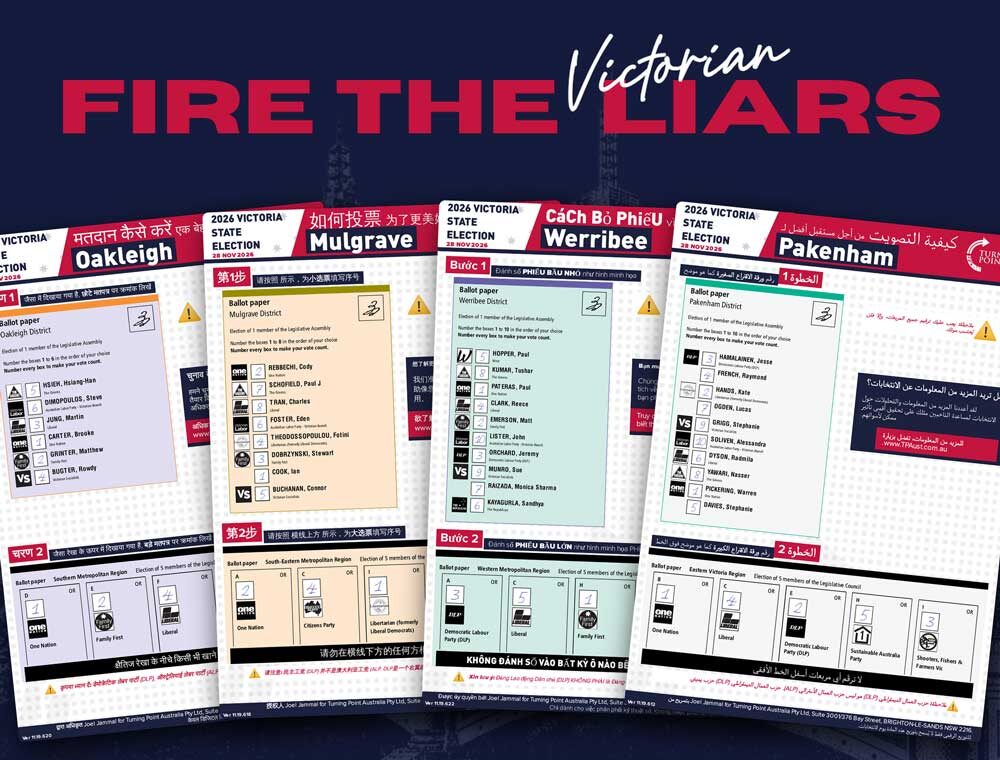
Turning Point Australia (TPAUS) has released how-to-vote cards in multiple languages for the first time this morning, ahead of the Victorian state election on Saturday 28 November. The cards were released in 10 languages other than English: Arabic, Chinese (Simplified), Filipino, Greek, Hebrew, Hindi, Italian, Punjabi (Gurmukhi), Spanish and Vietnamese.
The release targeted one of the fastest-changing features of Victorian politics. At the 2021 Census, almost 35 per cent of Victorians were born overseas, and many of those voters are more comfortable reading in their first language than in English.
TPAUS national director Joel Jammal said the cards were aimed squarely at voters who have not traditionally been approached by the political right.
“In a state where Melbourne is 30% foreign born and English is becoming less and less common, this will help decouple many Labor voters from their core voters,” Mr Jammal said.
He pointed to the voting patterns of two of Victoria’s largest migrant communities.
“Indians and Chinese, for example, generally vote 70-80% for Labor over right wing parties. That is exactly what we are trying to address,” he said.
Mr Jammal said TPAUS believed many of these voters held conservative views but had simply never been spoken to in their own language.
“There are natural conservatives that may not speak English that simply need to be reached out to in their language that want lower taxes, the ability to educate their kids without heavy LGBT ideology and safer communities,” he said.
Could it also help reduce informal voting?
Beyond persuasion, in-language cards may have a second benefit: helping more people cast a valid vote.
An informal vote is a ballot that has not been filled out correctly and cannot be counted. At the 2022 Victorian election, 5.53 per cent of Legislative Assembly (Lower House) votes were informal, down slightly from 5.83 per cent in 2018. In the Legislative Council (Upper House) the rate was 3.22 per cent.
The rate varied sharply across the state. The Victorian Electoral Commission (VEC) found Melton had the highest Lower House informal rate at 11.14 per cent, followed by Werribee at 9.72 per cent, while Hawthorn had the lowest at 2.59 per cent. In the Upper House, Dandenong was highest at 6.71 per cent.
The VEC’s review of the 2022 election linked informal voting to socio-economic factors, particularly English proficiency, speaking a language other than English, education and income. It found that pattern in metropolitan Melbourne, but not in regional Victoria.
The VEC also found that one type of mistake, using ticks or crosses instead of numbers, correlated strongly with speaking a language other than English. It suggested some migrant voters may have used ticks or crosses, which count as formal votes in their countries of origin, without realising the ballot would be rejected here. It recommended campaigns be tailored to different communities by country of birth.
The pattern is not new. After the 2010 federal election, the Australian Electoral Commission reported that electorates with the most informal votes were also those with large numbers of voters whose first language is not English. An earlier AEC pilot in Port Adelaide found that households from non-English-speaking backgrounds that received an in-language voter education letter were more likely to vote formally.
There is no research yet showing whether translated how-to-vote cards specifically cut informal voting. But given the evidence on language and informality, TPAUS’s cards may help reduce the informal vote in multicultural electorates, in addition to giving voters a clear guide in their own language.
The Victorian state election will be held on Saturday 28 November 2026, with early voting having opened on Wednesday 18 November.
